
Dual and Single Head stethoscopes modeled after the original Littmann stethoscopes
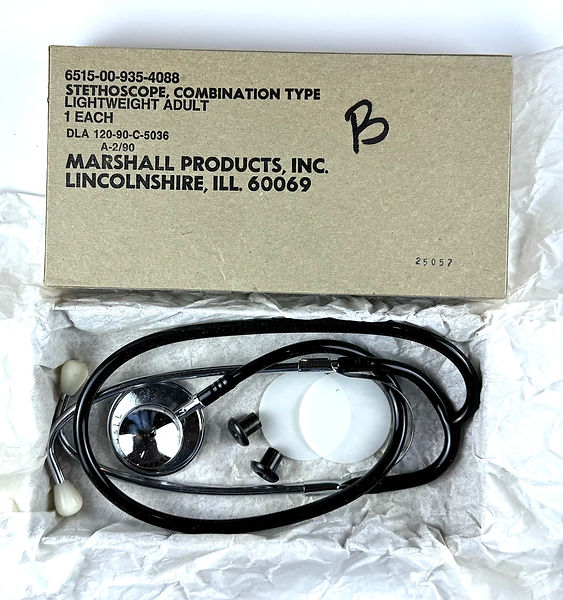
A Marshall Products Inc. combination lightweight stethoscope in original early crude cardboard box made by Marshall Products, Inc c. 1970

Marshall electronics , Inc. (Previously called Marshall Products, Inc.) Lightweight Nurses Stethoscope, c. 1972

A Marshall Electronics, Inc. Nurses' lightweight stethoscope, c. 1977. Note the more sophisticated cardboard box with a photo of the Norman Rockwell painting "Doctor and Doll" from the Saturday Evening Post 1929.

Omron Healthcare also made a "Marshall" Certified Sound professional dual-head stethoscope, c. 1977.

Omron Healthcare eventually changed their stethoscope name from "Marshall" to "Omron" Certified Sound professional dual-head stethoscope, c. 1980.

Labtron Non-Chill, Lightweight, Dual Head Stehtoscope Model 400 c. 1980

Labtron Nurses-Scope (single head) Model 330, c. 1980

Henry Schein Stainless Steel Stethoscope (dual head) introduced in 2004

Henry Schein Lightweight Essentials Nursescope (single head) c. 2009


Revival Surgicals in India made a cardiology dual head stethoscope introduced in 2006 and modeled after the Littmann cardiology stethoscope. Note the interesting logo that was incorporated into the name Revivial.

Dr. Tarek Loubani, an emergency physician working in the Gaza strip, developed a 3D-printed stethoscope as part of a project to bottom-out the cost of medical devices. Loubani together with a team of medical and technology specialists designed the stethoscope and tested it against global standard benchmarks, finding it performed as well as the gold-standard Littmann Cardiology stethoscope, which served as the basis for the 3D design. The Glia project was born in 2012, where Loubani and his medical colleagues were in short supply of the life-saving equipment and forced to listen to the heartbeats of scores of Gazans with ears placed on chests (Immediate auscultation). Dr. Loubani says the concept of the 3D-printed stethoscope was inspired after he tested his nephew's toy stethoscope and found it performed much better than expected. Since costs remained high despite the expiration of 1960s-era Littmann stethoscope design patents, Glia's team of boffins built the 3D-printed device, validated high quality acoustic stethoscope at a cost under $5 USD. It has been released as an open-source model for anyone to use.
(Validation of an effective, low cost, Free/open access 3D-printed stethoscope (2018).
A. Pavlosky, J. Glauche, S. Chambers, M. Al-Alawi, K. Yanev, T. Loubani https://doi.org/10.1371/journal.pone.0193087)